October 2026
Nonprofit functional expenses, under ASU 2016-14
By Winsome Anderson, CPA · Owner, W.A. Anderson CPA
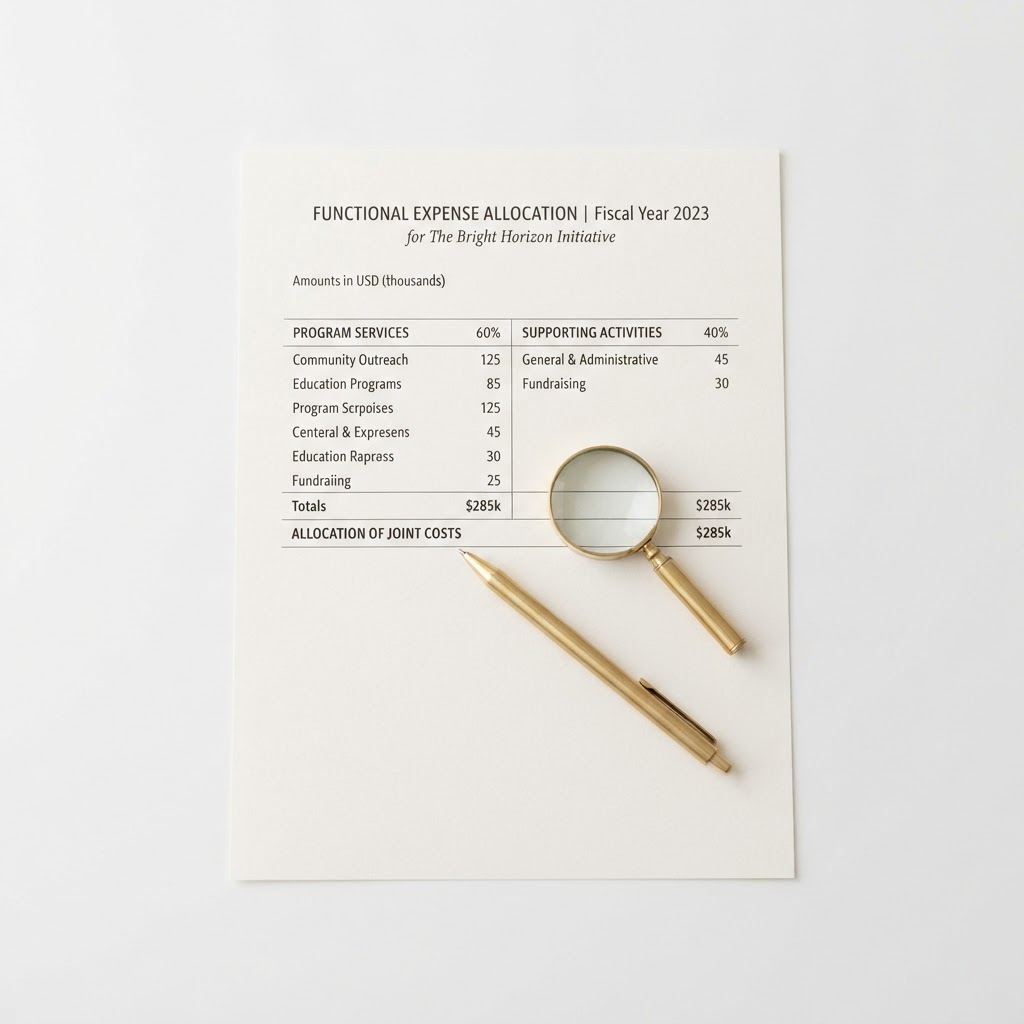
ASU 2016-14 requires nonprofits to present expenses by both nature, salaries, rent, professional fees, and function, program vs. supporting, in one place, and to describe the method used to allocate between them. It is one of the more visible lines a funder reads, and one of the easier ones to get wrong. The standard is not new, but it is still the line on the statement of activities that draws the most questions from a board and the most scrutiny from a funder. Getting it right is less about accounting complexity and more about saying, clearly, what you did and how you split the cost of doing it.
Nature is what the spend was. Function is what it accomplished. A program manager's salary is a salary by nature and program by function. The rent on the building is rent by nature and, depending on what happens inside it, could be program or supporting by function. The allocation method is the rule that assigns shared costs, like rent or the executive director, across program and supporting activities. The standard asks you to state that rule, not to invent a perfect one. A reasonable, consistently applied method beats an elaborate one that changes every year.
The reason this line matters to a funder is simple. A funder wants to know how much of every dollar went to mission and how much went to running the organization. There is no right answer to that question. A healthy nonprofit spends enough on administration to be well run, and not so much that the mission becomes an afterthought. The functional expense schedule is where that story gets told in numbers. When the numbers are clean and the method is stated, the funder can read the story and move on. When the numbers are muddy or the method is missing, the funder starts asking questions, and questions take time.
The most common error is not in the accounting. It is in the allocation. Shared costs, the executive director's salary, the building, the accounting software, have to be split between program and supporting. The split has to be stated, and it has to be the same split the organization actually uses. Too many nonprofits build the split at year end, in a spreadsheet, from memory. The result is a number that does not tie to anything else in the books, which is exactly the kind of number a funder learns not to trust. The fix is to build the allocation into the close, so the functional view is a byproduct of the month, not a project at the end of it.
The second most common error is hiding supporting costs in program. It is tempting, because a higher program percentage looks better in a grant application. But a funder who has read a hundred of these can spot it, and the loss of trust is not worth the point. A clean 78 percent program ratio that the funder believes is worth more than a polished 88 percent that they do not. The schedule is meant to be an honest picture, and an honest picture includes the cost of the finance function, the board, and the executive director. Those are not overhead to be ashamed of. They are the cost of an organization that can be trusted with the money.
We build the books so the functional expense schedule is a byproduct of the close, not a separate project at year end. A board can read it. A funder can read it. And the client's tax preparer and auditors are not reconstructing the year from a pile of receipts. The way we do it is straightforward. Every transaction gets a natural category, which is the easy part, and a functional tag, which is the part that has to be decided once and then applied consistently. Shared costs get an allocation rule that is written down, reviewed annually, and applied by the system, not by hand. The schedule that comes out the other side is the same one the auditor will test, because it was built from the same books.
There is a board-level point here that is worth saying out loud. The functional expense schedule is one of the few places where the board can see, in one glance, whether the organization is spending in a way that matches its mission. A board that reads only the statement of activities sees the total. A board that reads the functional expense schedule sees the shape. The shape is where the conversation should be: are we spending enough on program, are we spending enough on the systems that make program possible, and is the balance the one we want to present to the people who fund us. That conversation, held once a year with a clean schedule in front of it, is one of the more useful things a board can do.
For the funder, the schedule is a screen, not a verdict. A funder uses it to decide whether to look closer. A clean schedule with a stated method says look closer, we have nothing to hide. A schedule that is missing the method, or that moves the ratios around without explanation, says do not bother. The schedule is the first impression, and in fundraising, as in most things, the first impression is worth a lot of the second one.
The work, then, is not to build a perfect allocation. It is to build a consistent one, to state it plainly, and to let it fall out of the close. A nonprofit that can do that has answered the question a funder is actually asking, which is not can you account for the money but can you account for it in a way I can trust. ASU 2016-14 is the prompt. The trust is the point.
One practical closing note. The schedule is also the place where a nonprofit's audit and its tax return stop being separate projects. When the functional expense view is built into the close, the auditor tests the same numbers the board already saw, and the tax preparer pulls the same allocation the funder already read. Three audiences, one set of books. That is the real efficiency. Not less work, but the same work done once, believed by everyone who sees it. A nonprofit that gets its functional expense schedule right has, almost without trying, gotten its whole reporting year right.